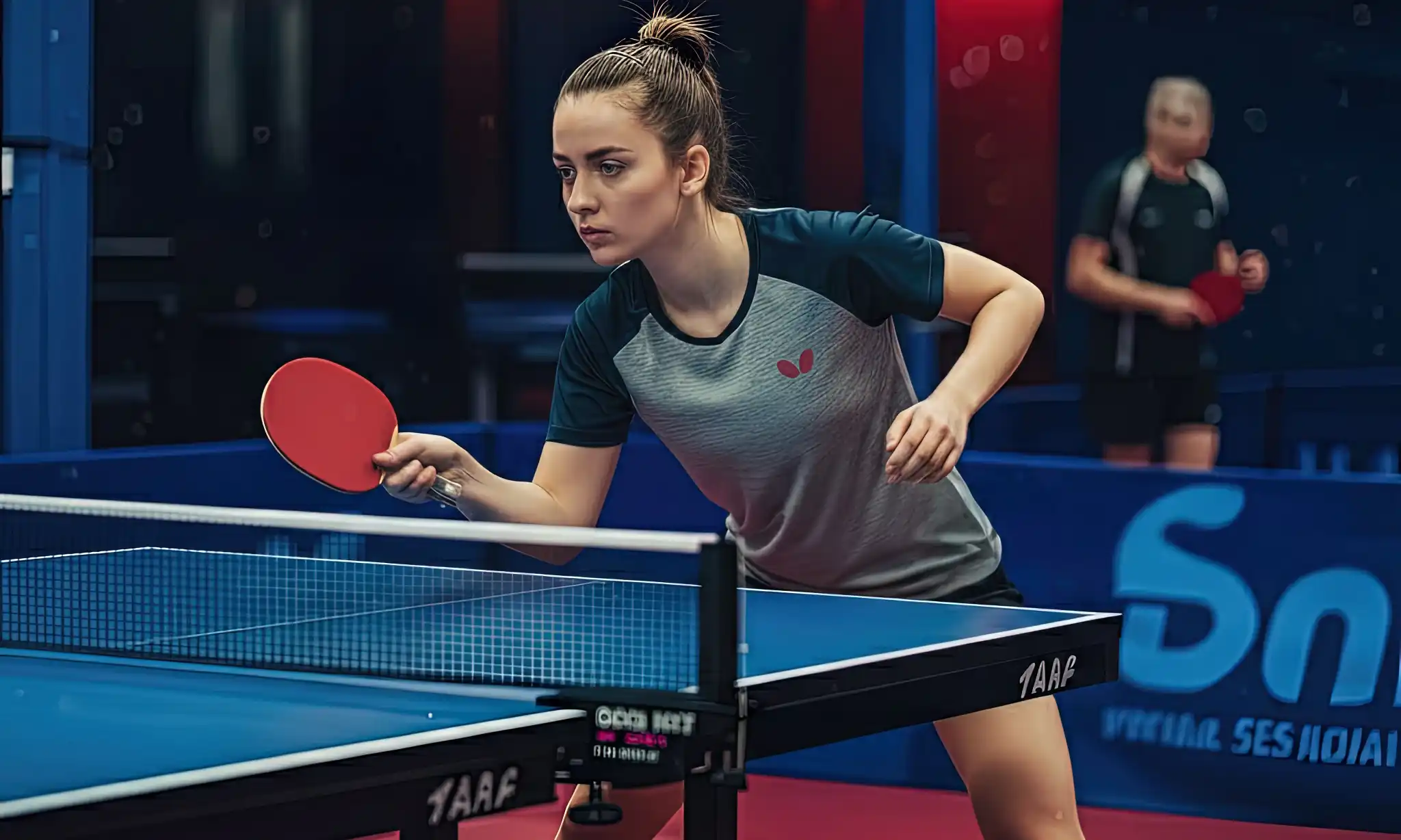
Table tennis, or ping pong, is a game of incredible speed, spin, and strategy. Watching top players execute lightning-fast rallies and physics-defying shots is mesmerizing. But how do you go from being a spectator in your basement to a confident player who can hold their own at a club? The journey is more accessible than you think.
This comprehensive guide is your starting point. We won’t just cover the basics; we’ll give you the foundation for a killer game, from choosing your very first paddle to developing a practice plan that builds real skill.
Key Takeaways
- Choosing the right beginner-friendly paddle and rubber is crucial for learning proper technique and control.
- Mastering the fundamentals—grip, stance, and the four basic strokes (Forehand Drive, Backhand Drive, Push, Block)—is the non-negotiable foundation for all advanced play.
- Table tennis is a game of spin. Learning to create topspin by “brushing” the ball is the most important step to unlocking intermediate and advanced play.
- Legal serves and scoring (games to 11, win by 2) are simple, but knowing the rules and club etiquette is essential for playing socially.
- A structured 30-day practice plan focusing on one new skill per week can rapidly take you from a complete novice to a consistent, confident player.
Before You Hit the Ball: Gearing Up for Success
You can’t learn proper technique with a cheap, plastic paddle from a department store. Your equipment is your first coach. It can either help you or hold you back.
Choosing Your First Paddle: A Hallmark Billiards Expert Breakdown
For your first paddle, you must avoid two common mistakes: choosing a paddle that is too fast or one that has no grip.
- Blade Speed: A beginner blade should be rated for “Control” or “All-Around” (ALL). A “fast” or “Offensive” (OFF) blade will make the ball fly off your paddle before you’ve had a chance to execute your stroke, crippling your ability to learn.
- Weight & Handle: Find a paddle that feels balanced in your hand. Most beginners start with a “flared” handle, which is comfortable and prevents the paddle from slipping.
- Our Recommendation: As experts, we guide new players toward pre-assembled paddles from reputable brands that are specifically designed for learning. These paddles balance control and spin, giving you the best chance to develop good habits.
Understanding Rubbers: How “Spin” and “Speed” Actually Work
The “rubber” is the red and black sheet on your paddle. For beginners, the most important factor is the “sponge” underneath.
- Sponge Thickness: A thick sponge (2.0mm or more) is fast and powerful. A thin sponge (1.5mm – 1.9mm) is slower and provides much more control, allowing you to “feel” the ball. Start with a thinner, control-oriented rubber.
- Tacky vs. Grippy: A “tacky” rubber (common in Chinese-style play) physically grabs the ball. A “grippy” rubber (common in European/Japanese-style play) uses its elasticity to generate spin. Both work, but a control-oriented grippy rubber is often the most forgiving for learning basic drives and spins.
The Right Balls for Practice vs. Competition
Not all balls are created equal. This table breaks down the differences:
| Ball Type | Key Features | Ideal Use |
| Practice Balls (1-Star/2-Star) | Less expensive, may not be perfectly round. | High-volume training, practicing drills, serves, or use in a robot. |
| Competition Balls (3-Star) | Highest quality, perfectly weighted, durable, and official standard. | Official matches, tournament play, and serious practice. |
Mastering the Fundamentals: Your Foundation for a Killer Game
You must build a strong foundation before you can add power and spin. Focus on these three areas relentlessly.
The 2 Essential Grips: Shakehand vs. Penhold (With Pictures)
Your grip is the only connection you have to the paddle.
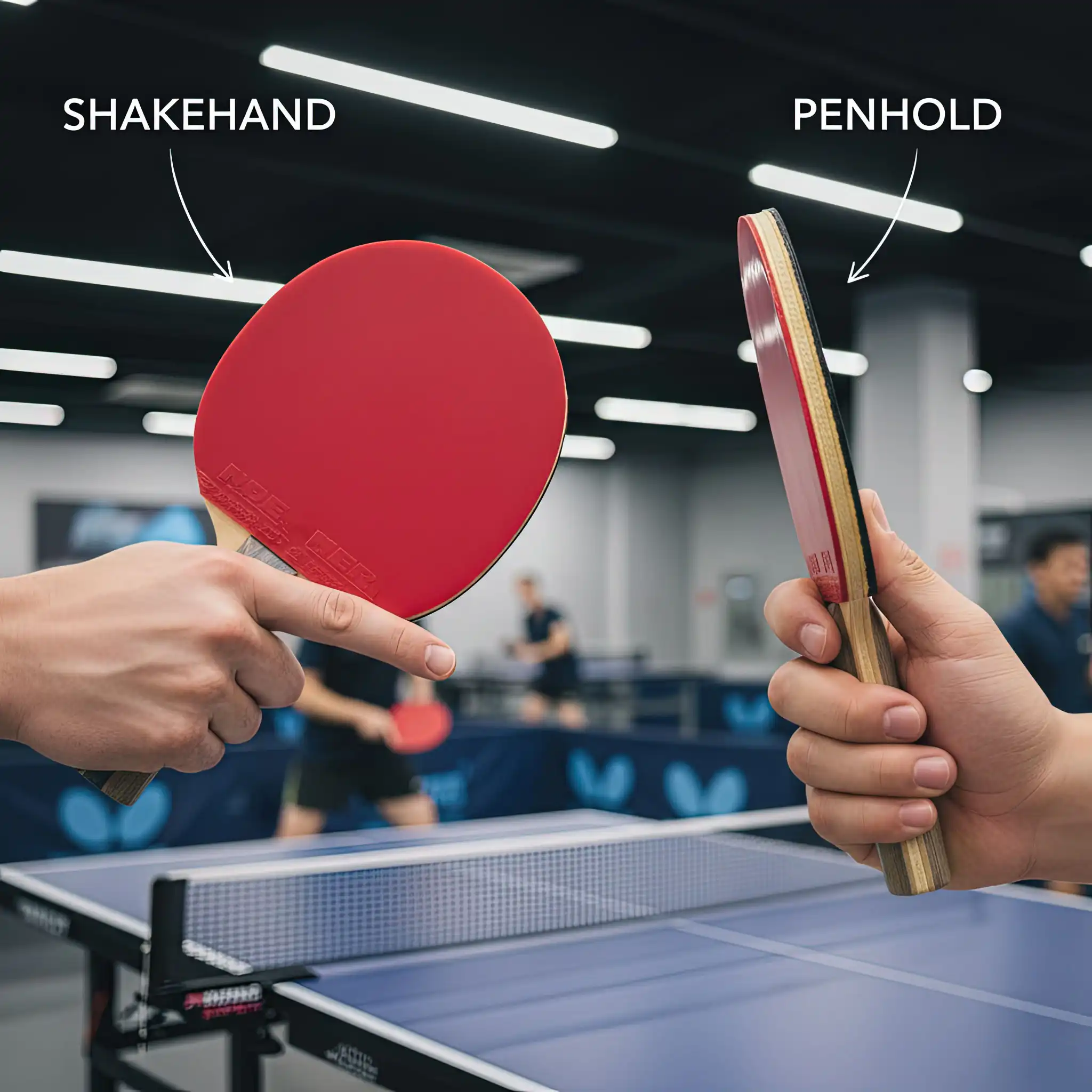
- Shakehand:
This is the most common grip in the world. As the name implies, you hold the paddle as if you are shaking someone’s hand. Your index finger rests on the backhand rubber, and your thumb rests on the forehand side. This grip offers a great balance between forehand and backhand strength. - Penhold:
This grip is held like a pen, with the thumb and index finger pinching the handle and the other three fingers resting on the backhand side. This allows for incredible forehand and serve creativity but requires advanced footwork and a more difficult backhand. Beginners are advised to start with the Shakehand grip.
The Ready Stance: How to Stand for Maximum Agility
You never stand flat-footed in table tennis. The ready stance is an athletic position that prepares you for any shot.
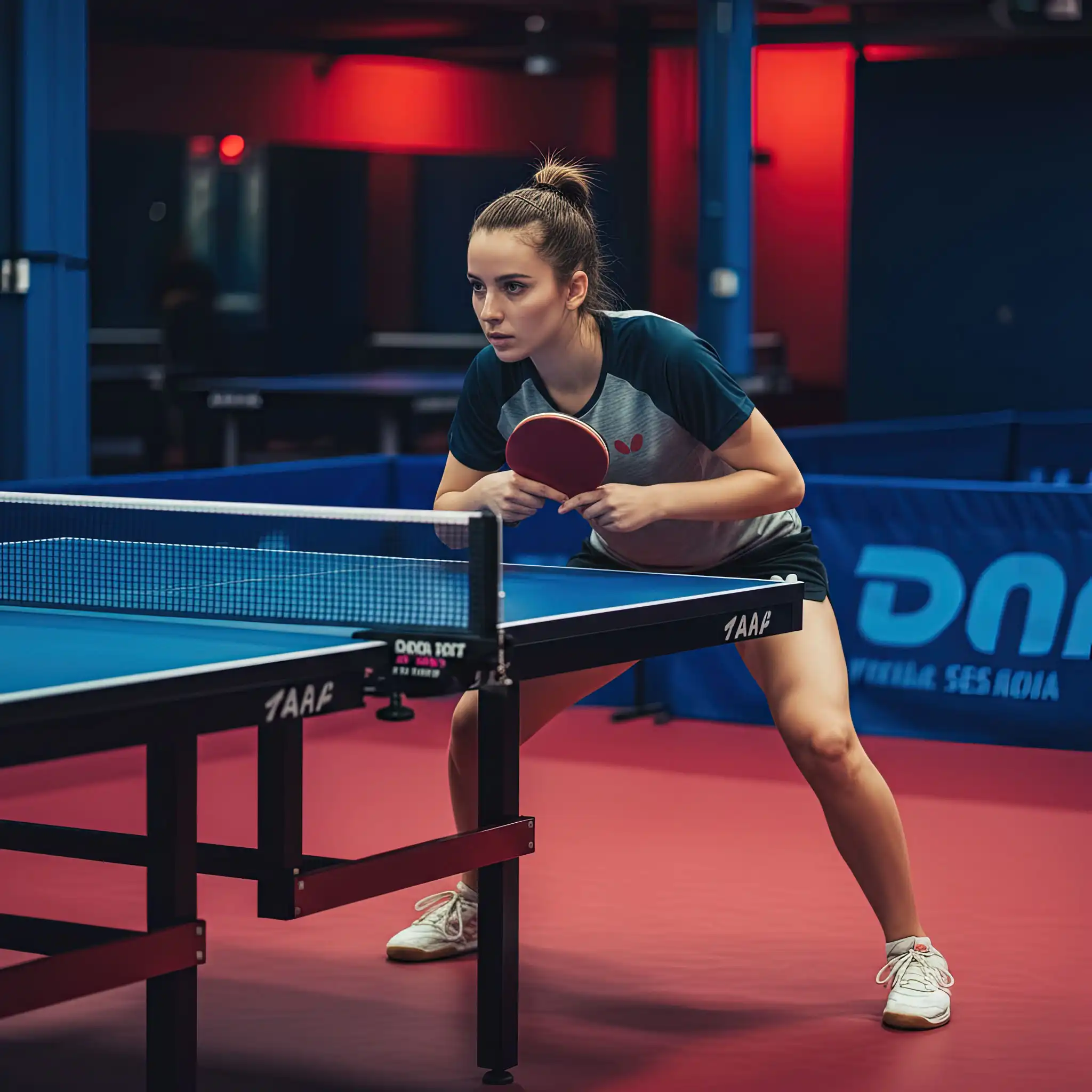
- Stand with your feet slightly wider than your shoulders.
- Bend your knees and lean forward slightly from the waist.
- Keep your weight on the balls of your feet, not your heels.
- Hold your paddle up and in front of your body, ready to react to either a forehand or backhand shot.
Basic Footwork Drills You Can Do at Home
Great table tennis is played with your feet, not your arms. Practice “shadow-swinging” (swinging without a ball) while moving.
- Side-to-Side Shuffle:
From your ready stance, take small, quick shuffles to your right, execute a forehand, and shuffle back to the middle. Repeat on the backhand side. - In-and-Out:
Practice moving forward to “push” a short ball and quickly moving back to prepare for a deep “drive.”
The 4 Essential Strokes Every Player Must Know
These four shots are the building blocks of 90% of all rallies.
Stroke #1: The Forehand Drive (Your Bread and Butter)
This is your main offensive weapon.
- From your ready stance, pivot your body, rotating your shoulders and hips back.
- Keep your paddle slightly closed (angled forward).
- As the ball approaches its peak, rotate your body forward, striking the ball in front of you.
- Your arm moves from “low to high,” brushing slightly up the back of the ball.
- Follow through, with your paddle finishing near your opposite shoulder.
Stroke #2: The Backhand Drive (Building Consistency)
This shot is used for fast, consistent rallies from your backhand side.
- Face the table squarely from your ready stance.
- Bring your paddle back to your stomach or hip.
- Keep the paddle angle slightly closed.
- Snap your forearm and wrist forward, striking the ball in front of your body.
- The follow-through is short and forward, pointing toward the net.
Stroke #3: The Push (The Ultimate Defensive Shot)
When your opponent gives you a low, backspin-heavy ball, you must “push” it back.
- Get low by bending your knees.
- Open your paddle face (angled slightly upward).
- Meet the ball in front of you and “slice” or “push” under it, sending the backspin back to your opponent.
- The stroke is short and gentle, originating from the elbow.
Stroke #4: The Block (Using Your Opponent’s Power)
When your opponent hits a fast drive or loop, a block is the easiest way to return it.
- Stay close to the table.
- Use your ready stance and simply “punch” the ball back, using the opponent’s own pace against them.
- The stroke is very short and compact. Just get your paddle in front of the ball with the correct angle.
Level Up: Adding Spin and Power to Your Arsenal
Once you are consistent with the 4 basic strokes, you can add weapons to your game.
Intro to Topspin: The Most Important Shot in Modern Table tennis
The “loop” or topspin drive is how modern players attack. Instead of just hitting the ball, you “brush” it. This is the key shot in modern table tennis.
- Get lower than you would for a drive.
- Close your paddle face even more.
- As the ball drops, accelerate up the back of the ball in a fast, grazing motion. This creates heavy topspin, which makes the ball dip and kick off the table.
The Backhand Loop: Generating Effortless Power
This is an advanced version of the backhand drive. You use more of your wrist and a faster upward-brushing motion to create topspin, allowing you to attack from your backhand side.
When and How to Use the Smash to End the Point
If your opponent hits a high, weak ball, it’s time to smash.
- This is a flat hit. Angle your paddle to hit the ball straight down.
- The stroke is long and powerful, using your whole body.
- Aim for a wide corner or at your opponent’s “pocket” (their playing elbow).
The Rules of the Game: How to Serve, Score, and Win
Don’t be the person who doesn’t know the rules. They are simple.
Serving Legally: Rules You Need to Know
You must follow these rules for a serve to be legal, even in friendly play.
- You must start with the ball resting on your open, flat palm.
- You must toss the ball at least 6 inches (16cm) straight up.
- You must strike the ball as it’s falling.
- Your toss and hit must be done “behind the table” (behind the end line).
- The ball must bounce once on your side, then once on your opponent’s side.
A Simple Guide to Scoring a Match
- Games are played to 11 points.
- You must win by at least 2 points (e.g., 11-9, 12-10).
- Service alternates every 2 points.
- At 10-10 (“deuce”), service alternates every single point until one player is up by 2.
- A match is typically the best 3 out of 5 games or 4 out of 7 games.
Common Etiquette for Playing at a Club or Community Centre
- Wait for Your Point to Finish: If your ball rolls into another court, wait for those players to finish their point before asking for it or walking on to retrieve it.
- Respect the Equipment: Never hit the table with your paddle or lean on it.
- Announce the Score: It’s good practice for the server to announce the score clearly before serving.
From Your Basement to the Big Leagues: Where to Play in Toronto & the GTA
You can only get so good playing at home. The real improvement happens when you play against different people at a dedicated club.
Find Your Club: Top-Rated Table Tennis Centres in Mississauga, Vaughan, and Across the GTA
The Greater Toronto Area has a vibrant table tennis community. Finding a club is the best way to get consistent practice and find playing partners.
- Mississauga: Look for clubs like the My Table Tennis Club (MTC) or the CCTTA, which offer coaching, leagues, and drop-in play.
- Vaughan: Areas in and around Vaughan have dedicated facilities perfect for all skill levels.
- Across the GTA: From Markham to Scarborough and downtown Toronto, there are numerous community centres and private clubs (like the Elite Table Tennis Training Centre) that welcome new players.
- A quick search will find clubs with professional coaches and group classes perfect for beginners.
Joining Your First League or Tournament
Most clubs run weekly leagues broken down by skill level or “rating.” This is the perfect way to test your new skills in a friendly, competitive environment. For more advanced tips on competitive play, many club players follow blogs from top brands and players. Don’t be afraid to join the “beginner” or “under-1000” rating group.
Your First 30 Days: A Practice Roadmap
Use this plan to build your skills methodically. This scannable roadmap breaks down your first month of practice.
| Week | Focus / Goal | Key Drill(s) |
| Week 1 | Consistency Drills (Forehand/Backhand) Goal: Hit 20 forehand drives in a row. | Partner hits all balls to your forehand. Then, switch and have them hit all balls to your backhand. Focus on smooth strokes and footwork, not power. |
| Week 2 | Mastering the Push Goal: Hold a “push-to-push” rally. | Serve backspin, your partner pushes, you push back. Focus on keeping the ball low and aiming for corners. Practice moving in and out. |
| Week 3 | Introducing Topspin Goal: Successfully “loop” a backspin push. | Have your partner push a backspin ball to your forehand. Instead of pushing it back, practice your forehand topspin loop. Focus on brushing the ball, not hitting it flat. |
| Week 4 | Putting It All Together Goal: Play full practice matches to 11. | Play, play, play. Focus on using all your new skills in a match setting: legal serves, looping pushes, and blocking drives. |
Frequently Asked Questions (FAQ)
What’s the difference between “ping pong” and “table tennis”?
Technically, nothing. “Ping Pong” was a trade name, while “table tennis” is the official name of the sport. We explore the evolution of table tennis in more detail on our blog.
How often should I practice?
Consistency is more important than duration. Practicing for 1-2 hours, twice a week, will lead to much faster improvement than one 4-hour session every weekend.
Do I really need lessons?
While not mandatory, even a few lessons from a certified coach can correct bad habits before they become permanent. A coach can fix your grip, stance, and stroke in minutes, saving you months of frustration. For a deeper dive, check out our comprehensive guide from beginner to pro.
Conclusion
Table tennis is a lifelong sport that is as mental as it is physical. The journey from beginner to skilled player is a rewarding one, built step-by-step on a solid foundation. It starts with the right equipment, transitions to mastering the fundamental strokes, and blossoms when you join the vibrant local community in the GTA. Focus on the fundamentals, practice consistently, and most importantly, have fun.
For expert advice on choosing the perfect table tennis equipment to start your journey, contact Hallmark Billiards today.