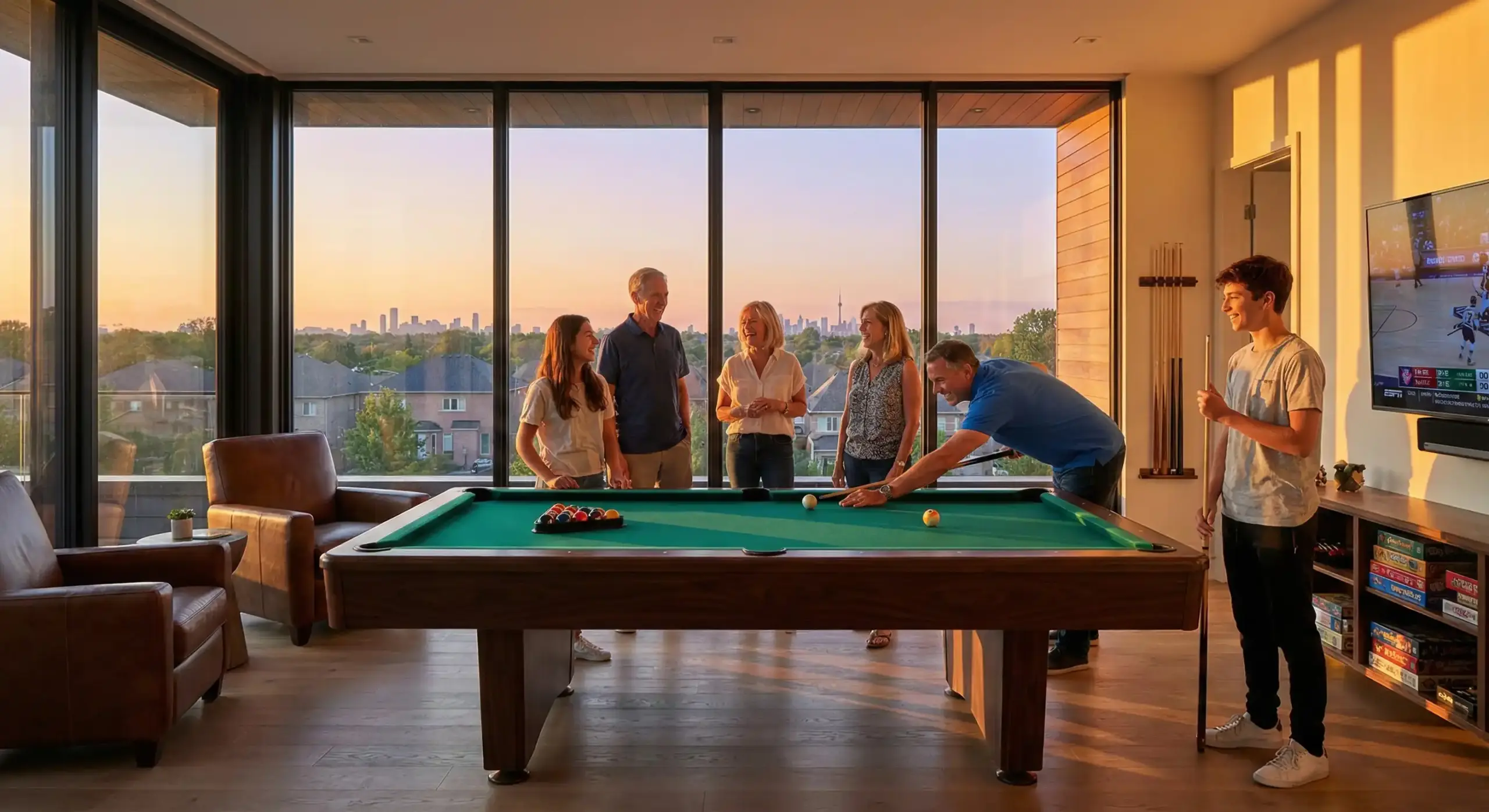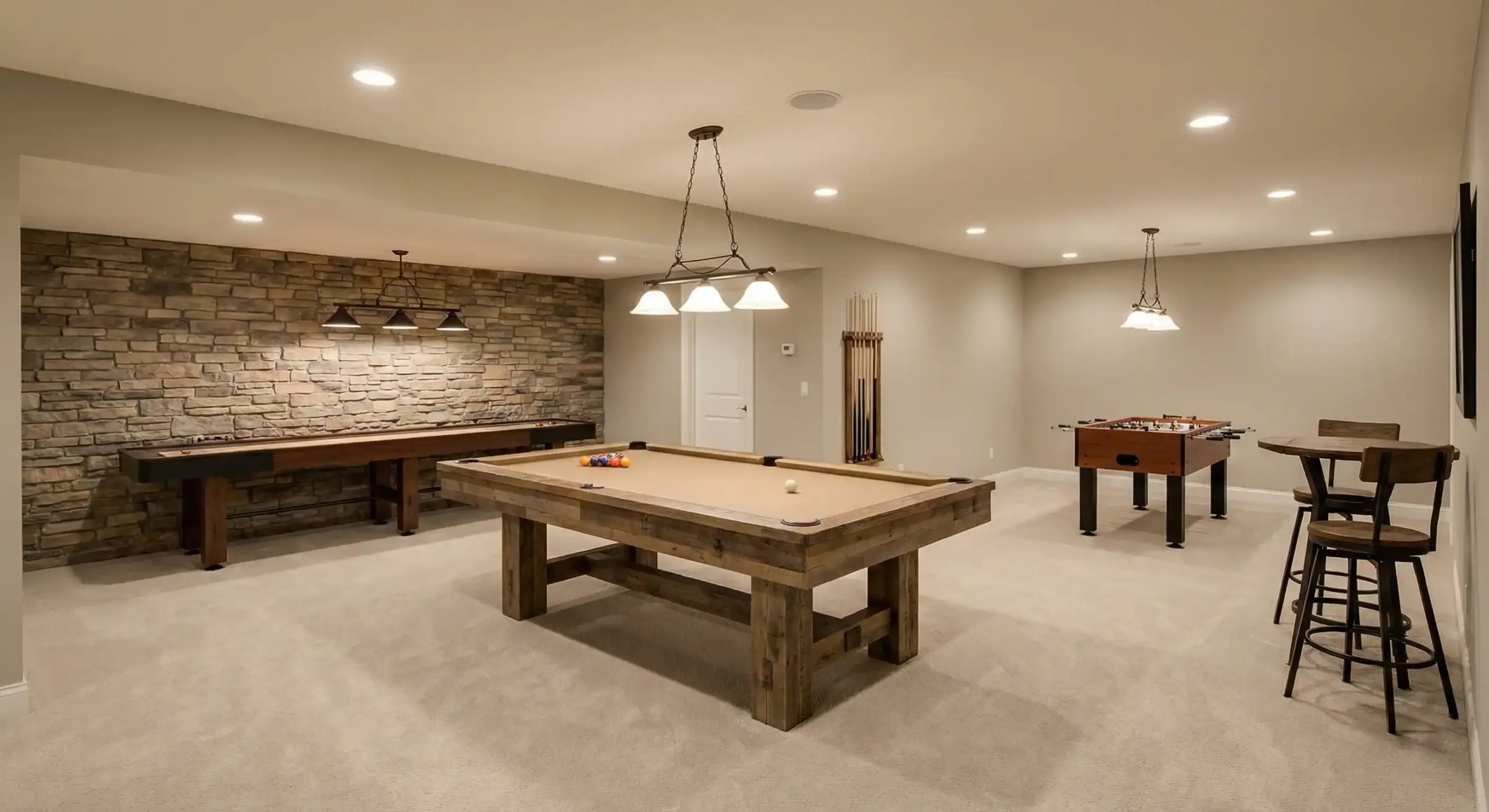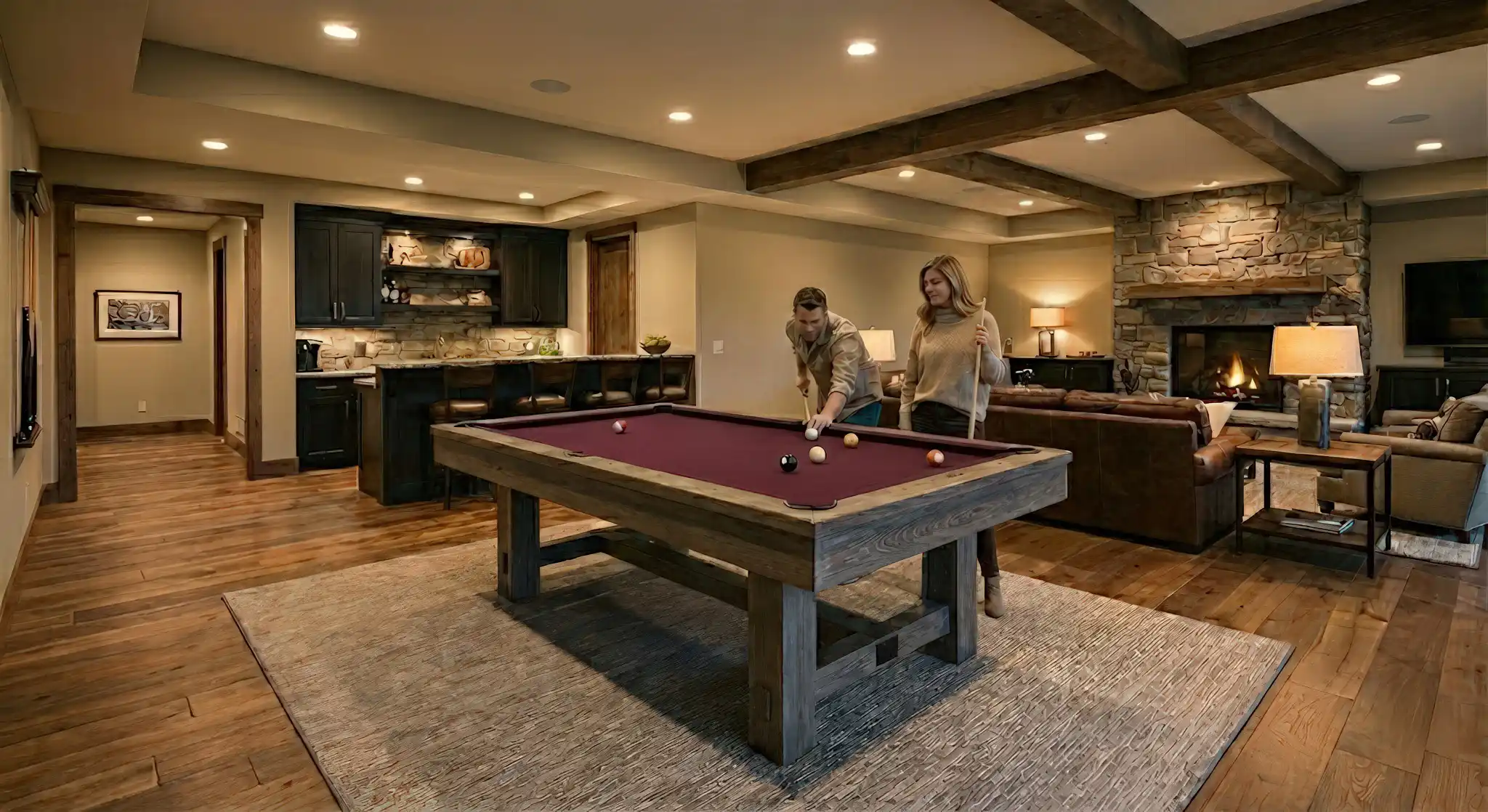
For many homeowners in the Greater Toronto Area, the dream of a dedicated game room often begins with a vision of gathering friends around a beautiful slate pool table. However, that excitement can quickly turn to anxiety when faced with the reality of floor plans. Will a regulation table actually fit in a standard Mississauga basement? How much room do you really need to shoot comfortably without hitting a wall?
At Hallmark Billiards, we have guided thousands of clients through these exact questions over the last three decades. The difference between a room that feels cramped and one that plays like a professional arena often comes down to inches. This guide moves beyond basic size charts to provide the expert, localized advice you need to choose the perfect table for your space, your budget, and your game.
Key Takeaways
- The “Standard” is 8-Foot: While 9-foot tables are used in professional tournaments, the 8-foot table is the overwhelming choice for residential game rooms, offering the best balance of playability and fit.
- The Golden Rule of Clearance: You generally need at least 5 feet of clearance around every side of the table to accommodate a standard 58-inch cue stroke.
- Size Dictates Difficulty: A larger table requires more precision; smaller tables (7-foot) are often more fun for families and casual play.
- Basements Require Planning: In GTA homes, support columns and bulkheads are common obstacles, but they can often be managed with strategic table placement or shorter “trouble cues.”
- Budget Implications: Moving from an 8-foot to a 9-foot table often incurs higher costs for the slate, cloth, and professional installation required.
First Things First: Understanding Standard Pool Table Sizes
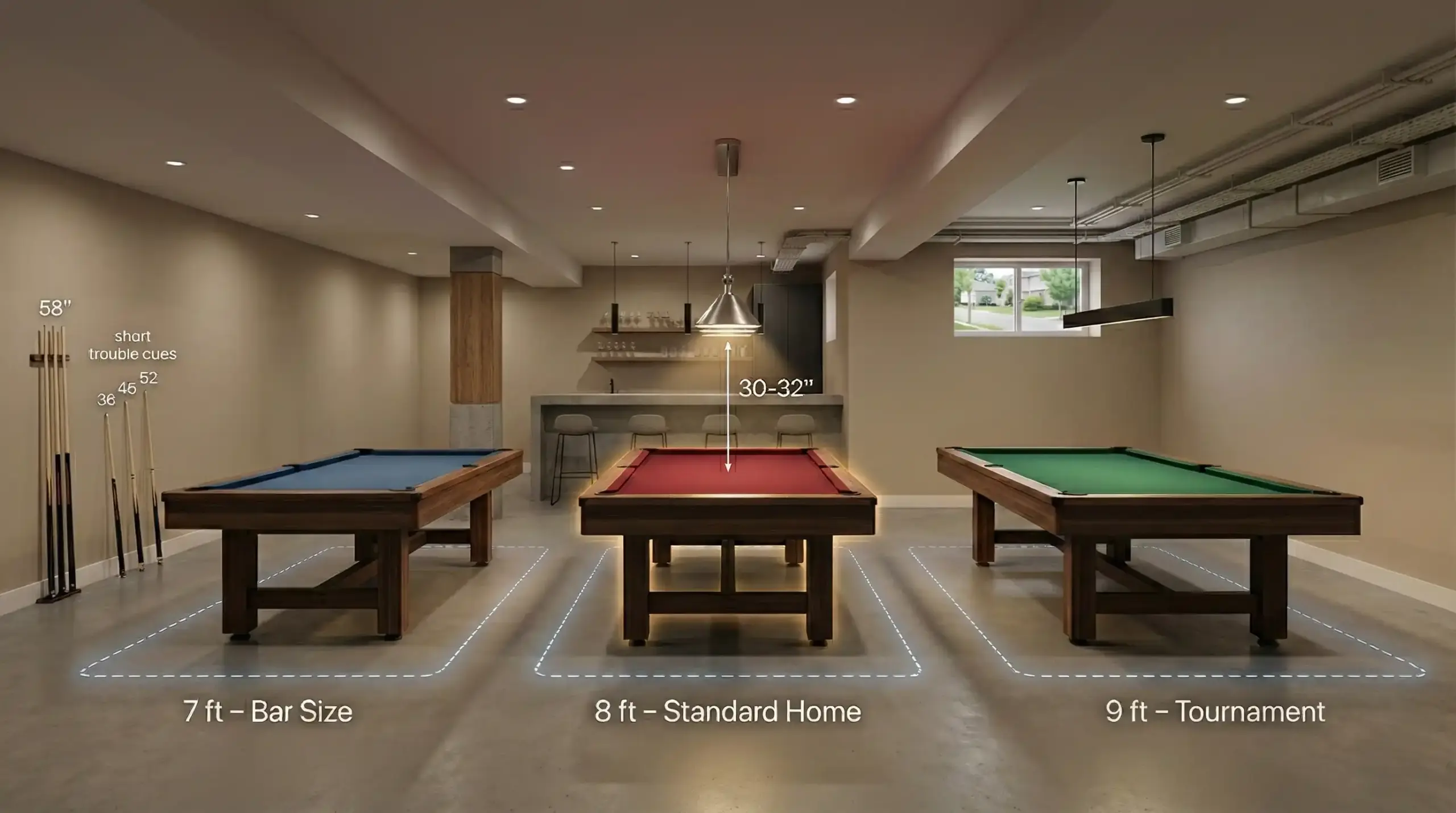
Before measuring your room, it is critical to understand what you are actually measuring for. In the billiards industry, tables are generally categorized into three primary sizes. Note that the “size” refers to the approximate length of the table, but the playing surface dimensions are the precise metrics used for technical planning.
Pool Table Dimensions Chart (ft & cm)
| Table Size | Approximate Outside Dimensions | Playing Surface Dimensions |
| 7-Foot (Bar Size) | 52″ x 90″ (132 cm x 228 cm) | 39″ x 78″ (99 cm x 198 cm) |
| 8-Foot (Standard Home) | 58″ x 102″ (147 cm x 259 cm) | 44″ x 88″ (112 cm x 224 cm) |
| 9-Foot (Tournament) | 64″ x 114″ (162 cm x 290 cm) | 50″ x 100″ (127 cm x 254 cm) |
What is a “Regulation” Tournament Table? (9-ft)
There is often confusion surrounding the term “regulation.” Technically, the World Pool-Billiard Association (WPA) and Billiard Congress of America (BCA) recognize the 9-foot table as the standard for professional tournament play. If you watch events on TV, this is what the pros are using. A 9-foot table offers a massive playing surface (50″ x 100″), requiring high precision and excellent cue ball control. While prestigious, it requires a very large room, making it less common for the average home.
What is the Standard “Home” Table? (8-ft)
The 8-foot table is the “Goldilocks” size for residential use. It is large enough to feel substantial and allow for skilled play, yet compact enough to fit comfortably in most finished basements and recreation rooms. When someone mentions a “standard home pool table,” they are almost always referring to an 8-foot model. This size is the primary focus for manufacturers like Brunswick and Olhausen for the residential market.
What is a “Bar Box” Table? (7-ft)
The 7-foot table is affectionately known as the “bar box” because it is the coin-operated size found in pubs and bars across North America. While smaller, it is a legitimate size for serious play—many amateur leagues compete exclusively on 7-foot tables. For smaller rooms or multi-purpose spaces, a high-quality 7-foot table can save space without sacrificing the fun.
The Critical Question: How Much Space Do You Actually Need?
The most common mistake buyers make is measuring only for the physical footprint of the table. You are not just buying furniture; you are creating a playing field. You need room to stand, bend, and extend your arm for a shot.
The #1 Rule: Planning for Cue Clearance
To play pool without frustration, you need enough space for the length of the cue stick plus the room for your backswing. The standard cue length is 58 inches. Therefore, the general rule of thumb is that you need 5 feet (60 inches) of clear space around all four sides of the playing surface. This ensures that even when the cue ball is frozen against the rail, you can take a full stroke without your handle hitting the wall.
Room Size Calculator: Find Your Perfect Fit
To calculate the ideal room size, use this simple formula:
(Playing Surface Length + 2x Cue Length) by (Playing Surface Width + 2x Cue Length)
For example, for an 8-foot table using standard 58-inch cues:
- Length: 88″ + 58″ + 58″ = 204 inches (17 feet)
- Width: 44″ + 58″ + 58″ = 160 inches (13 feet, 4 inches)
For a quick reference and additional layouts, you can also consult our dedicated pool table room size page.
Minimum Room Size Chart (Using Standard 58″ Cues)
| Table Size | Minimum Room Dimensions (Feet) | Minimum Room Dimensions (Meters) |
| 7-Foot Table | 13′ x 16′ | 3.96m x 4.87m |
| 8-Foot Table | 13′ 4″ x 17′ | 4.06m x 5.18m |
| 9-Foot Table | 14′ 6″ x 18′ 4″ | 4.42m x 5.59m |
Don’t Forget Vertical Space: Ceiling Height & Lighting Fixtures
While floor space is the priority, vertical clearance matters too. Standard billiard lights should be hung approximately 30 to 32 inches above the playing surface. In many GTA basements where ceiling height can be restricted (often 7 or 8 feet), you must ensure that low-hanging fixtures do not interfere with tall players or elevated cue strokes, such as when using a mechanical bridge or jumping a ball.
Beyond the Basics: Matching Table Size to Your Skill Level & Goals
Choosing a size isn’t just about fit; it’s about the “feel” of the game. The size of the table dramatically changes the dynamics of play.
For Family Fun & Beginners: Why a 7-ft or 8-ft Table is Ideal
If your primary goal is family entertainment or casual gatherings, a 7-foot or 8-foot table is often the superior choice. On a smaller table, shots are shorter, and pockets are relatively closer. This keeps the game moving and reduces the frustration of constantly missing long, difficult shots. It encourages potting balls and keeps the “fun factor” high for children and guests.
For the Serious Player: The Challenge and Reward of a 9-ft Table
A 9-foot table is often called the “Green Mile” for a reason. The extra length makes every shot significantly harder. Position play becomes critical because moving the cue ball from one end of the table to the other requires more force and precision. For the serious enthusiast looking to compete in WPA events or truly master the sport, practicing on a 9-foot table is essential training.
How Table Size Affects Ball Spread and Shot Difficulty
On a larger table, the balls are more spread out after the break. This reduces “clusters” (balls tied up together) but increases the difficulty of potting. Conversely, on a 7-foot table, the balls often remain clustered, requiring players to develop skill in breaking out balls and playing safety shots. Understanding this trade-off helps you choose a table that matches the style of game you enjoy most.
A GTA Homeowner’s Guide: Overcoming Common Space Challenges
Houses in the Greater Toronto Area present unique architectural challenges for game rooms. From older Toronto homes with narrow access to suburban basements with structural pillars, we have seen it all.
Planning Around Basement Support Columns
Finished basements in Mississauga, Brampton, and Markham often feature support teleposts. If a post falls within the 5-foot clearance zone, you don’t necessarily have to abandon your pool table plans. We can position the table so the post interferes with only one specific angle of play. For those rare shots where the post is in the way, a shorter “trouble cue” (36″, 42″, or 48″) is the perfect solution.
Narrow Rooms & Townhouses: Using Shorter Cues
Modern townhouses often have long, narrow recreation rooms. If your room is 12 feet wide instead of the recommended 13′ 4″, you can still comfortably fit an 8-foot table by using 52-inch cues for shots perpendicular to the side rails. Most players barely notice the difference in cue length, and it allows you to maximize the table size for the room.
Measuring Stairwells and Doorways for a Successful Delivery
One of the most overlooked aspects of buying a pool table is getting it into the room. Slate tables are heavy and are delivered in pieces (cabinet, legs, slate slabs). However, the cabinet of a solid-wood table can be bulky. Tight turns in stairwells or narrow basement walk-outs can be tricky. As part of our service, we recommend measuring the narrowest point of your entry path to ensure a smooth delivery.
Installing a Brunswick Table in a Mississauga Basement
We recently worked with a client in Mississauga who wanted a Brunswick table but had a lally column exactly 4 feet from where the side pocket would be. They feared they would be stuck with a 7-foot table. By analyzing the room layout, we shifted the table 6 inches off-center. This provided full clearance on three sides and only necessitated a 48-inch cue for shots directly off the rail near the column. The client got the 8-foot table they wanted without compromising 95% of their gameplay.
The Financial Factor: How Size Impacts Your Budget
While the aesthetic difference between 8-foot and 9-foot tables may seem subtle, the cost difference can be significant.
Why Slate Thickness and Table Size Drive Cost
The slate is the most expensive component of a high-quality table. A 9-foot table requires significantly more slate than an 8-foot model. Furthermore, regulation 9-foot tables often use thicker 1-inch slate (or even thicker for specialized tables), which increases material and shipping costs. Moving up to a tournament size generally pushes you into a higher price tier.
Installation & Delivery Costs: What to Expect
A larger table is heavier and more cumbersome to handle. Installing a 9-foot table requires more labor to level the three pieces of slate perfectly over a larger surface area. Additionally, the cloth required to cover a 9-foot bed is more expensive than for standard sizes. When budgeting, expect a slight premium for the delivery and setup of tournament-sized equipment.
Long-Term Value: Investing in the Right-Sized Table
Resale value is also a consideration. Because 8-foot tables fit in most homes, they are easier to resell on the secondary market. 9-foot tables have a much smaller pool of potential buyers (those with large enough rooms). However, for the right buyer, a well-maintained Brunswick or Olhausen tournament table retains its value as a sought-after piece of professional equipment.
Next Steps: Explore Our Brunswick & Olhausen Collections
Now that you understand the sizing requirements, the fun part begins: choosing the style that fits your game room furniture and decor.
View Our Recommended 8-ft Tables for Most Homes
Our showroom features a wide array of 8-foot Brunswick and Olhausen tables, ranging from traditional carved wood designs to modern, industrial styles. These are perfect for the standard 13′ x 17′ room.
View Our Tournament-Ready 9-ft Tables
For those with the space and the passion, we carry select tournament-grade tables that bring the professional arena into your home. Experience the difference of playing on the same equipment used by the pros.
Schedule a Free Consultation at Our Mississauga Showroom
The best way to feel confident in your choice is to see the sizes in person. Visit us at our Mississauga showroom to stand next to the tables, hold a cue, and visualize how they will look in your home. Our experts can review your room dimensions and help you select the perfect fit.
Frequently Asked Questions (FAQ)
Can I put a pool table in a 12×12 room?
A 12×12 room is generally too small for a standard pool table if you want to use full-length cues. Even with a 7-foot table, you would likely need to use shorter cues for almost every shot. For a room of this size, you might consider a bumper pool table or other game tables.
Does a 7-foot table use the same size balls as an 8-foot table?
Yes, standard American pool balls (2.25 inches in diameter) are used on 7-foot, 8-foot, and 9-foot tables. The pockets on a 7-foot table are proportional, so while the balls are the same size, the game can feel slightly more congested.
How far should a pool table be from the wall?
Ideally, you want 5 feet (60 inches) from the edge of the playing surface to the wall. This accommodates a standard 58-inch cue plus room for your backswing. If you have tight spots, you can get away with as little as 4 feet if you use shorter cues for shots near the wall.
Conclusion
Choosing the right pool table size is a balance between your available space, your budget, and your playing goals. While the 8-foot table remains the standard for most GTA homes, understanding the nuances of room dimensions and clearance ensures you won’t face any surprises on installation day. Whether you are navigating support columns in a basement or maximizing a townhouse rec room, the right planning leads to a lifetime of enjoyment.
For professional advice on fitting the perfect table into your home, contact Hallmark Billiards today or visit our Mississauga showroom for a personal consultation.