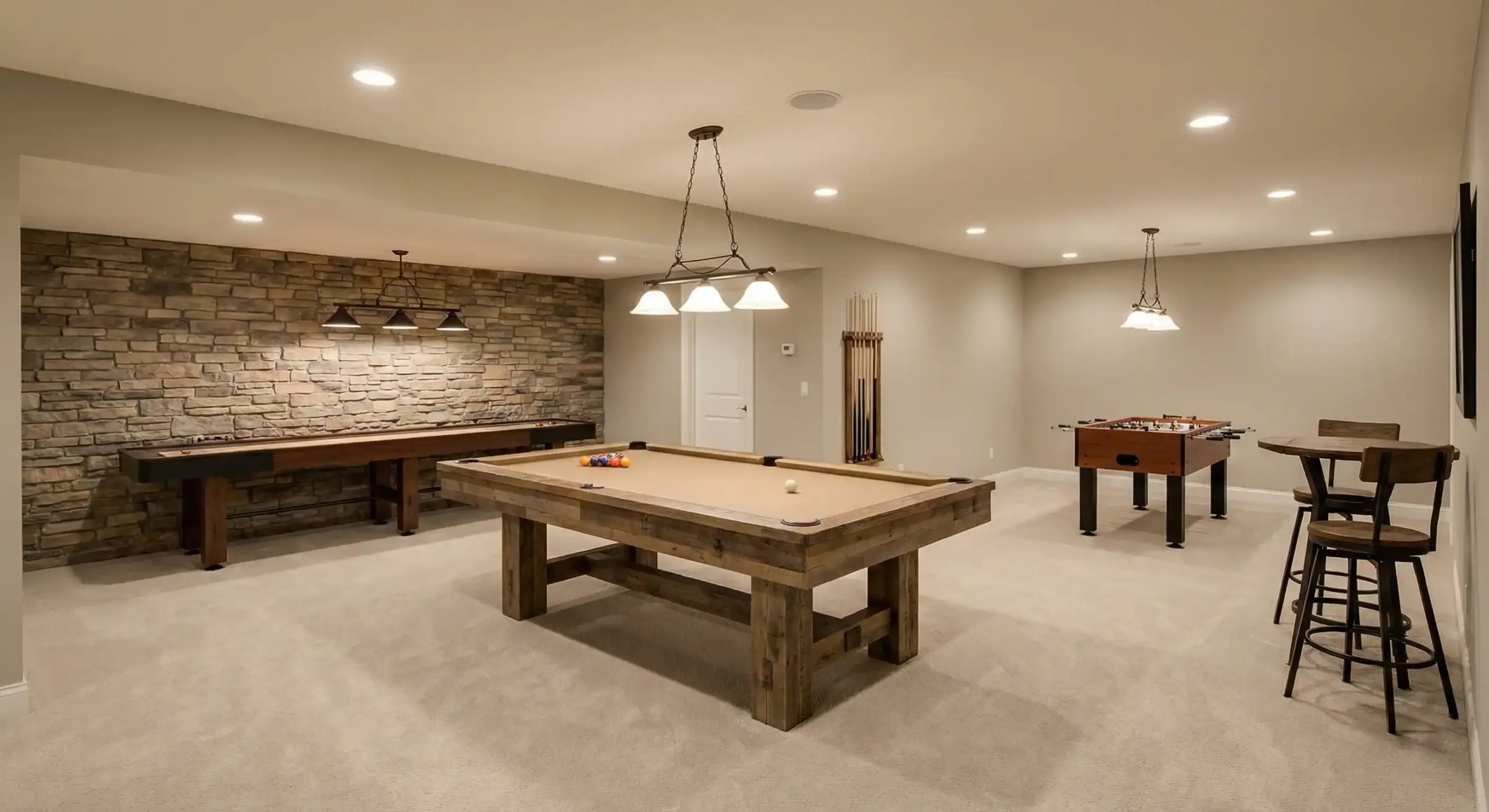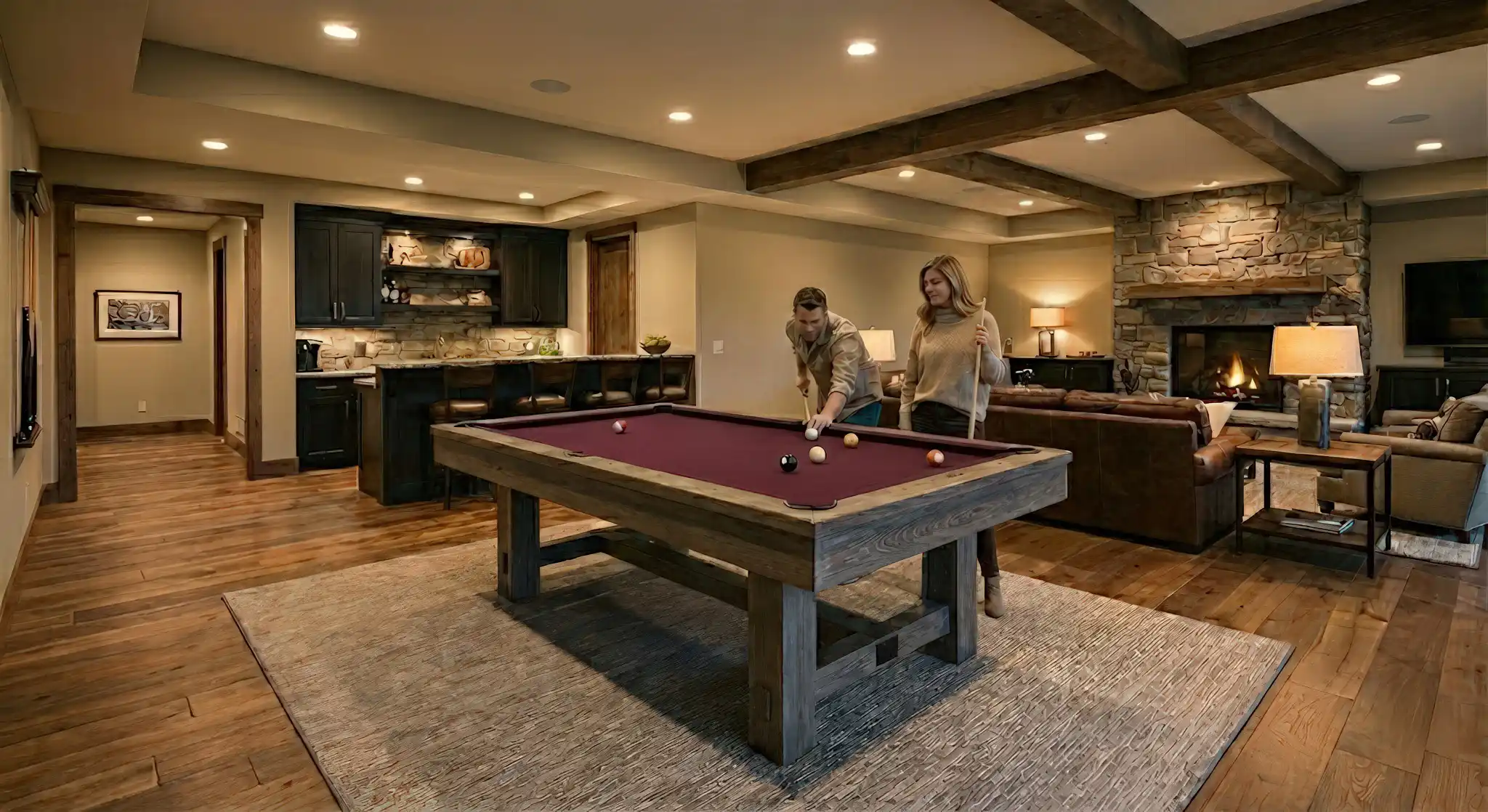
Most pool table owners eventually hit a wall. You’ve played hundreds of frames of 8-Ball. You’ve dabbled in 9-Ball. But after a while, doing the same thing over and over can feel repetitive. You have this beautiful, championship-quality piece of furniture in your home—likely the centerpiece of your game room—but you’re only utilizing a fraction of its potential.
At Hallmark Billiards, we have spent over five decades helping families in Mississauga and the Greater Toronto Area create the ultimate entertainment spaces. We know that a pool table is an investment in connection and fun. The secret to keeping that excitement alive isn’t buying a new table; it’s learning a new game. Whether you have a house full of guests or just a quiet evening alone, there is a discipline perfectly suited for the moment. This guide will move you beyond the basics, introducing you to games that demand different strategies, accommodate different group sizes, and test your skills in entirely new ways.
Key Takeaways
- Match the Game to the Crowd: Don’t force 8-Ball on a group of five. Games like Cutthroat are specifically designed for odd numbers and social play.
- Skill Development: Different games hone different mechanics. 9-Ball teaches position play and speed control, while One Pocket is the ultimate teacher of defensive strategy.
- Equipment Matters: The quality of your slate and cloth directly impacts your ability to play precision games like Straight Pool or Bank Pool effectively.
- Endless Variety: From the bowling-inspired scoring of Bowlliards to the defensive battles of Cutthroat, there is a variation for every skill level and mood.
How to Choose the Right Game for Any Occasion
The most common mistake hosts make is defaulting to 8-Ball regardless of who is in the room. To get the most out of your table, you need to select a game that fits the number of players and their skill levels.
Best Games for Two Players (Head-to-Head Competition)
When it is just you and one opponent, you want a game that allows for rhythm and flow.
| Game | Ideal For | Why It Works |
| 8-Ball | Standard Play | The classic choice that allows for rhythm and flow. |
| 9-Ball | Cue Ball Control | Forces you to move around the table in a specific pattern, making it superior for testing position play. |
| One Pocket | Pure Strategists | Known as the “chess of pool,” this involves a mental battle to score in a single assigned pocket while preventing your opponent from doing the same. |
Best Games for Parties & Groups (Social & Fun)
Standard pool games can be slow for large groups, leaving too many people sitting on the sidelines. For parties, you need games with high engagement and faster turnover. Cutthroat is the king of social play, perfect for 3 or 5 players. The goal is to be the last person with balls remaining on the table, which encourages playful rivalries and alliance-building. Killer is another excellent party option where players must simply pocket a ball—any ball—or lose a “life.” It moves fast and levels the playing field between novices and experts.
For casual leagues or friendly tournament nights, many hosts adopt the simplified rule sets popularized by the American Poolplayers Association (APA), which are designed to keep the game moving and accessible for all skill levels.
Best Games for Beginners (Learning the Fundamentals)
If you are teaching a child or a beginner, complex rules can be discouraging. Basic 8-Ball (often played without calling pockets) remains the best entry point because it allows for the most choices; you usually have multiple stripes or solids available to shoot at. Straight Pool drills are also effective. Simply racking 15 balls and trying to sink as many as possible without strict rules helps beginners learn the physics of the table without the pressure of stripes-versus-solids constraints.
Best Games for Advanced Players (A True Test of Skill)
For the serious enthusiast, the game must punish mistakes and reward precision. 14.1 Continuous (Straight Pool) is the game of champions. It requires players to call every shot and think multiple racks ahead. Bank Pool is another variation that removes “slop” entirely; every shot must be banked off a rail to count. Serious students of the game often follow professional tournaments covered by Billiards Digest to see these high-level strategies executed by the pros.
These games require a perfectly level slate table, like the Brunswick and Olhausen models we carry, to ensure true rolls on sensitive shots.
The Classics: Essential Pool Games Everyone Should Know
To truly master your game room, you need a deep understanding of the “Big Three” games. While “house rules” are common, we recommend consulting the official regulations set by the World Pool-Billiard Association (WPA) or the Billiard Congress of America (BCA) if you want to play by the book.
Eight-Ball: The World’s Most Popular Pool Game
- Best For: 2 Players (or teams), All Skill Levels
- Primary Skill: Shot making, simple position play.
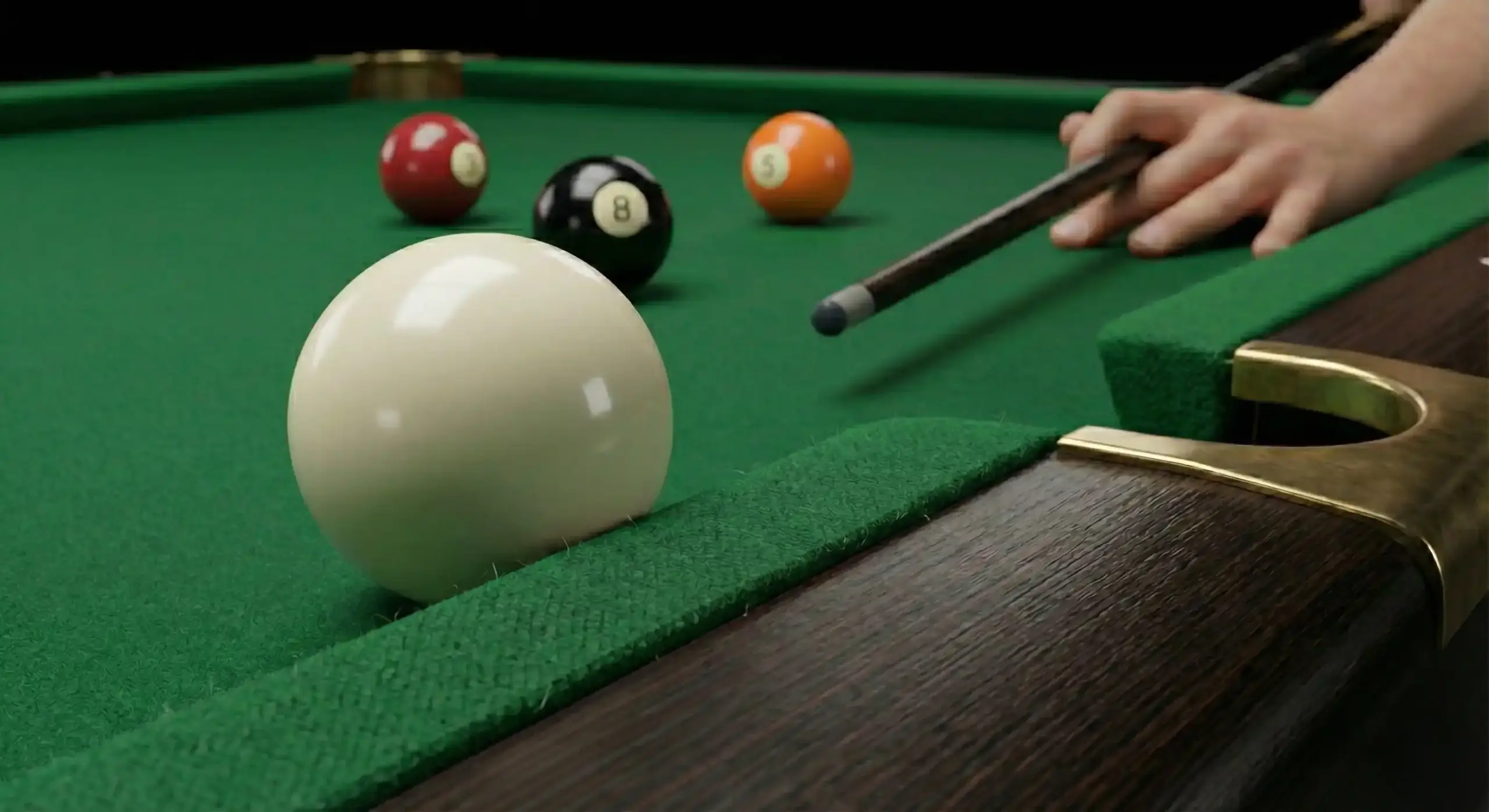
How to Rack & Rules:
The rack is a triangle shape. The 8-ball must be placed in the absolute center of the triangle. The two bottom corners must contain one stripe and one solid to ensure an even break. The apex ball is placed on the foot spot.
The objective is to claim a suit (stripes or solids) and legally pocket all seven of your group before sinking the 8-ball to win. A crucial but often overlooked rule in standard play is that the 8-ball shot must be “called”—you must designate the pocket you intend to sink it in. If the 8-ball goes into the wrong pocket or scratches, you lose the game.
Nine-Ball: The Fast-Paced Professional’s Choice
- Best For: 2 Players, Intermediate to Advanced
- Primary Skill: Pattern play, cue ball control.
How to Rack & Rules:
9-Ball uses a diamond-shaped rack containing balls numbered 1 through 9. The 1-ball is at the front (on the foot spot), and the 9-ball is in the dead center. The rest of the balls can be placed randomly around them.
The golden rule of 9-Ball is “rotation.” You must always contact the lowest-numbered ball on the table first. However, you do not need to sink the balls in order. If you hit the lowest ball and it knocks the 9-ball into a pocket, you win instantly. This “combo potential” makes the game fast and unpredictable. The game ends when the 9-ball is legally pocketed.
Cutthroat: The Ultimate Party Game (3 or 5 Players)
- Best For: Groups, Social Gatherings
- Primary Skill: Defensive strategy, targeting opponents.
How to Rack & Rules:
Cutthroat uses a standard triangle rack with all 15 balls. The 1-ball, 6-ball, and 11-ball are placed in the three corners of the triangle.
The game is unique because you are trying to protect your own balls while sinking your opponents’. The balls are divided into three groups:
- Player A: Balls 1-5
- Player B: Balls 6-10
- Player C: Balls 11-15
If you sink an opponent’s ball, you keep shooting. If you scratch, your opponents get one of their previously pocketed balls back on the table. The winner is the last player with at least one ball remaining on the felt.
Beyond the Basics: Unique Games to Surprise Your Friends
Once you have mastered the classics, try these variations to keep your game nights fresh.
Bowlliards: The Perfect Game for Solo Practice
As the name suggests, this is a hybrid of bowling and billiards. You set up ten balls in a triangle. You have two chances (innings) per frame to sink them all. If you sink all 10 on the first attempt, it’s a strike. If you miss, re-rack the remaining balls for a spare attempt. It is a fantastic way to quantify your progress and play a “perfect game” solo.
Bottle Pool: A Game of Nerves and Precision
This old-school game uses a specialized “shake bottle” placed upside down on the table. The goal is to score exactly 31 points by caroming the cue ball off object balls to knock the bottle over. It requires delicate touch and is a favorite among players who appreciate the physics of the game.
Snooker: The Strategic Cousin from Across the Pond
While usually played on a larger 12-foot table, Snooker can be adapted for standard American pool tables. It involves 15 red balls and 6 coloured balls, each with different point values. Players must alternate between sinking a red (1 point) and a colour (2-7 points). The smaller pockets and stricter rules regarding fouls make this a game of extreme precision and patience.
Carom & Three-Cushion: The Art of Billiards Without Pockets
True “billiards” technically refers to games played on pocketless tables, but you can practice the principles on your home table. In Three-Cushion, the goal is to strike the cue ball so that it contacts three rail cushions before hitting the second object ball. It teaches an advanced understanding of angles and spin (English) that will dramatically improve your standard pool game.
How Your Equipment Shapes the Game: An Expert’s Perspective
A game is only as good as the surface it is played on. At Hallmark Billiards, we see firsthand how equipment choices influence gameplay.
Why a Slate Table is Crucial for Games of Precision
In games like One Pocket or Straight Pool, the ball often needs to travel the entire length of the table at a very slow speed (“lag speed”). On a non-slate table (like wood or MDF), the surface will inevitably warp or bow over time, causing the ball to roll off course. A one-inch slate bed, standard on our Brunswick and Olhausen tables, ensures that gravity doesn’t interfere with your strategy.
Choosing the Right Felt: How Cloth Speed Affects 9-Ball vs. 8-Ball
The cloth (or felt) you choose changes the game’s physics. Traditional woolen cloth (often called “napped” cloth) is slower and fuzzy. This is excellent for 8-Ball, where control is paramount. However, competitive 9-Ball players often prefer worsted wool (like Simonis cloth), which is smoother and faster. This speed allows the cue ball to travel further with less effort, making the cross-table position plays required in 9-Ball much easier to execute.
Does a Brunswick or Olhausen Table Really Make a Difference?
Yes, specifically regarding “rail consistency.” In banking games like Bank Pool, you rely on the rail to rebound the ball at a predictable angle. Premium tables use high-grade cushion rubber that provides a consistent “liveliness” along the entire rail. Cheaper tables often have dead spots, making bank shots a game of luck rather than skill.
Find Your Perfect Game at Hallmark Billiards
The world of billiards is vast, extending far beyond the solid-and-stripe battles of 8-Ball. By exploring these variations, you unlock the full value of your game room, turning a piece of furniture into a lifetime of new challenges. Whether you are looking to install a new table that can handle the rigors of daily play or need advice on the right cues for spinning the cue ball, we are here to help.
Frequently Asked Questions (FAQ)
What is the difference between pool and billiards?
Technically, “billiards” serves as the umbrella term for all cue sports. However, historically, it specifically referred to carom games played on tables without pockets. “Pool” generally refers to pocket billiards games like 8-Ball and 9-Ball.
Can I play Snooker on a standard pool table?
Yes, but with modifications. Standard American pool balls are larger (2 ¼ inches) than Snooker balls. You can buy a set of Snooker balls sized specifically for American tables to play the game correctly without the balls jamming in the pockets.
Which pool game is the hardest to master?
Most professionals consider One Pocket or 14.1 Continuous (Straight Pool) to be the most difficult. One Pocket requires intense defensive knowledge, while Straight Pool requires unbreakable mental focus to run hundreds of balls in a row without missing.
What size room do I need for a pool table?
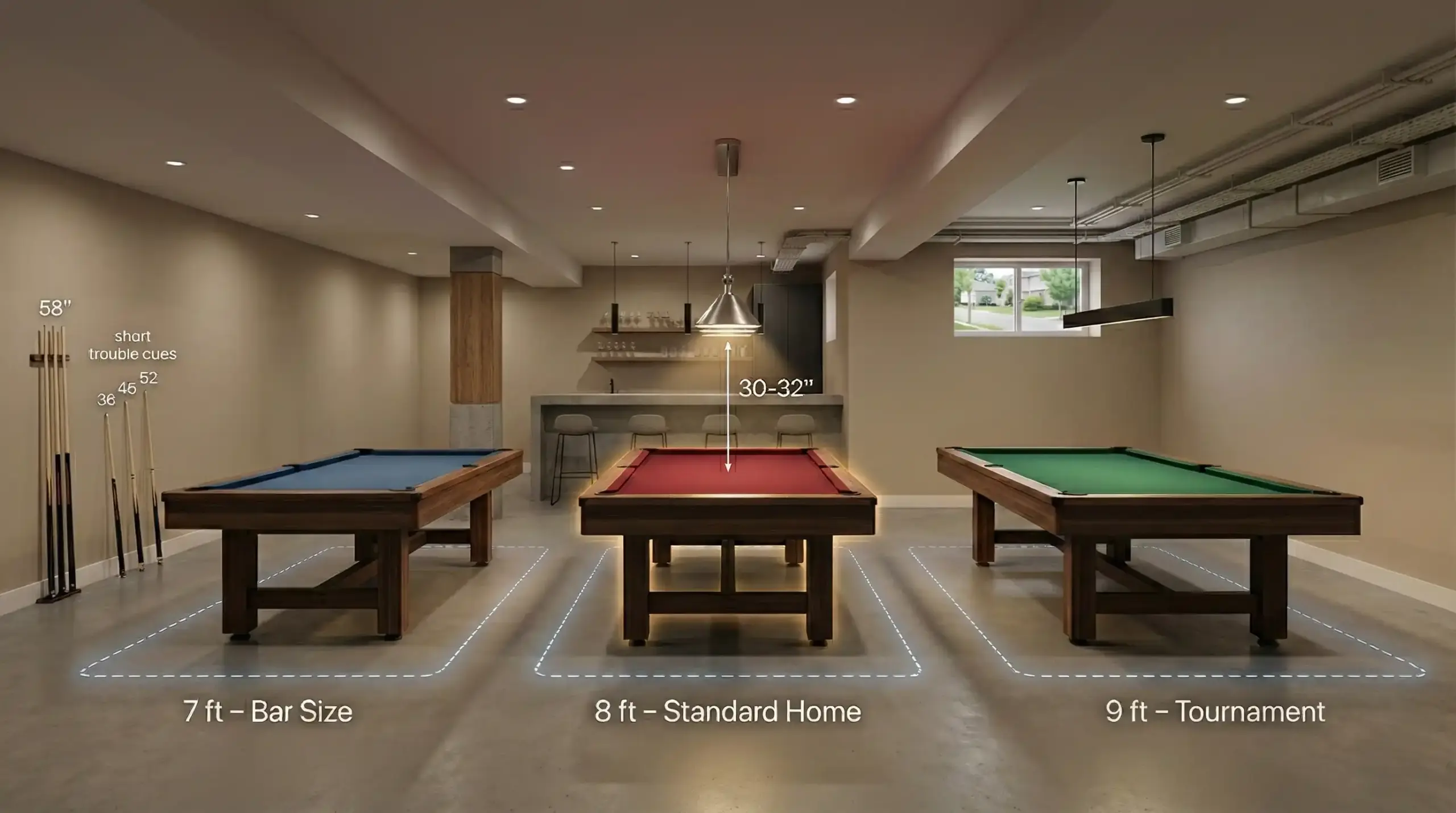
To play comfortably without your cue hitting the wall, you generally need at least 5 feet of clearance around the entire table. For a standard 4×8 foot table, a room size of roughly 14′ x 18′ is ideal.
For professional game room advice and to view our collection of Brunswick and Olhausen tables, visit our showroom in Mississauga or contact Hallmark Billiards today.